Sales Is Hard. Staying Positive Is Harder. Here’s What I Learned

Sales Is Hard. Staying Positive Is Harder. Here's What I Learned

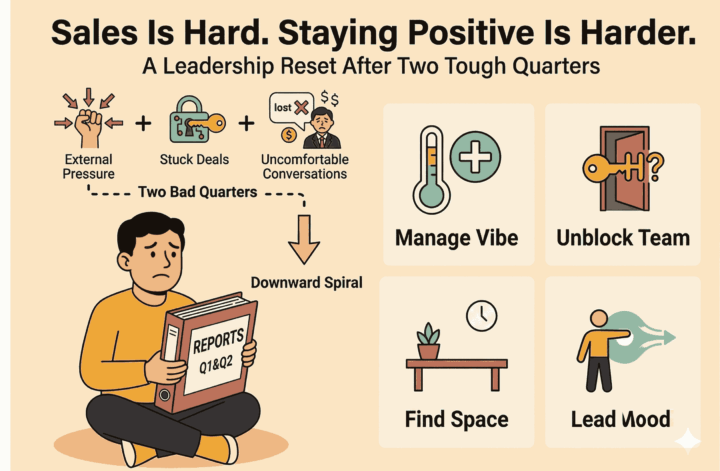
There’s a specific kind of exhaustion that comes from two bad quarters in a row.

It’s not just tiredness. It’s the weight of knowing your team is working hard, you’re working hard, and the results just aren’t showing up. Deals are getting stuck in procurement. Deals are going to lost. The pipeline looks okay on paper but nothing is closing. You’re doing stand-ups, reviewing calls, adjusting messaging and still, nothing moves.

I have recently experienced it. And what I learned during that period had less to do with sales tactics and more to do with something far more basic: the mood I chose to walk into every single day.

Two Quarters of “Why Isn’t This Working?”

It started with one missed quarter. That’s not unusual in sales, targets are ambitious by design, and one miss is something most teams can absorb. But when the next quarter started heading the same direction, the pressure shifted into something different.

From the outside, it looked like a pipeline problem. From the inside, it felt like everything was slightly broken at once. Deals that should have closed were stuck in review. Deals that had good momentum went silent. Some got marked lost without a clear reason. Every week felt like treading water.

What made it harder was that this pressure wasn’t just internal. As someone in a leadership role, I was also facing my boses and investors. And facing them when the numbers aren’t moving is genuinely one of the most uncomfortable places to be in. They ask tough questions. They want real answers. And the honest answer sometimes is: we don’t fully know yet, but we’re working on it.

That’s a hard thing to say. And it’s even harder to say it and then walk back into the office and lead a team that needs energy from you.

Negativity Doesn’t Announce Itself

Here’s the thing about negativity in a sales environment: it rarely shows up as someone throwing a chair across the room. It’s much quieter than that.

It shows up as a team that stops bringing problems forward because they expect to be blamed. It shows up as deals sitting stale in the CRM because no one wants to flag that they’re stuck. It shows up as a gradual drop in the quality of conversations, fewer ideas, fewer questions, fewer people willing to take a risk on a creative approach.

I noticed this and asked myself a simple question: where is this starting from?

The uncomfortable answer was that it was partly starting from me. Not intentionally, but when leadership is visibly stressed, visibly frustrated, asking “why didn’t this work?” more than “how do we fix this?”, it spreads. People pick up on that energy faster than any company memo.

Sales teams are made up of people who deal with rejection every single day. Their resilience is not unlimited. If the environment they come back to after a tough call is also negative, you’ve taken away the one place where they can reset and try again.

The Question That Changed How I Led

Somewhere in those two quarters, I made a deliberate shift in how I showed up to deal reviews and team conversations.

I stopped asking “why are we losing this?” and started asking “how can I help unblock this?”

It sounds small. It isn’t.

The first question puts a person on the defensive. They come to the meeting ready to explain themselves, not ready to problem-solve. The second question signals that we’re on the same side, that my job is to help them succeed, not to audit their failures.

Practically, this looked like: when a deal went stuck, instead of reviewing what went wrong, we’d spend the first ten minutes asking what we could still do. Could we bring in a different stakeholder? Could we offer a pilot? Was there a case study we hadn’t shared yet? Was there something the prospect hadn’t told us directly that we could read between the lines?

Sometimes there was nothing more to do. But often, there was at least one thing we hadn’t tried. And that one thing was only visible when the person who owned the deal felt safe enough to think creatively rather than defensively.

Positivity, in a sales context, is not about pretending things are fine. It’s about refusing to let the bad results become the ceiling for what your team believes is possible.

You Can’t Outsource Your Mood

The other thing I had to get honest with myself about was this: no one was going to manage my mindset for me.

When you’re facing your bosses and investors with bad news, when deals aren’t closing, when you’re two quarters in and you’re tired, it’s tempting to let that exhaustion set the tone for the day. I’ve felt it.

But in sales, and especially in a leadership role, your energy is contagious in both directions. If you show up flat, your team feels it. If you show up with a clear head and a “let’s figure this out” approach, they feel that too.

My routine during those two quarters became very deliberate. I’d start the morning without immediately jumping into pipeline reviews or Slack. I’d give myself twenty minutes to think, plan, and get into the right headspace before engaging with the team. Not because I was avoiding reality but because I knew that how I engaged with reality was something I could actually control.

There’s a version of positivity that is naive, the kind that ignores warning signs and pretends everything is great when it isn’t. That’s not what I’m talking about. I’m talking about the kind of positivity that acknowledges “this is hard” and then asks “what are we doing about it?” rather than sitting in the hard part.

Preparing For The Next Quarter

Two bad quarters are behind us. Next one is about to begin. I don’t know how it will go, no one does. There are no guarantees in sales, and I’ve stopped pretending otherwise.

What I do know is this: we’re showing up.

Not with blind optimism. Not pretending the last six months didn’t happen. But with a clear head, a team that still believes something can be done, and the discipline to take the next right action even when the mood isn’t perfect.

That’s really what staying positive in sales comes down to. It’s not a feeling. It’s a decision you make every morning, to do the work anyway. To make the call anyway. To follow up on the stuck deal anyway. Small actions, done consistently, even when the results aren’t showing up yet.

A bad result from a full day’s work is always better than no result from a day spent paralysed by the bad quarter behind you.

If you’re in a rough patch right now, missing targets, losing deals you thought were solid, facing pressure from above and below, I won’t promise that staying positive will fix your pipeline. It won’t, not directly.

But it will keep you in the game long enough to let the work start paying off. And you can’t win a quarter you’ve already mentally checked out of.

Show up. Do the small things. The scoreboard will catch up.

Continue Reading

Founder vs Sales Rep-Led Sales: My Experience

Founder vs Sales Rep Sales

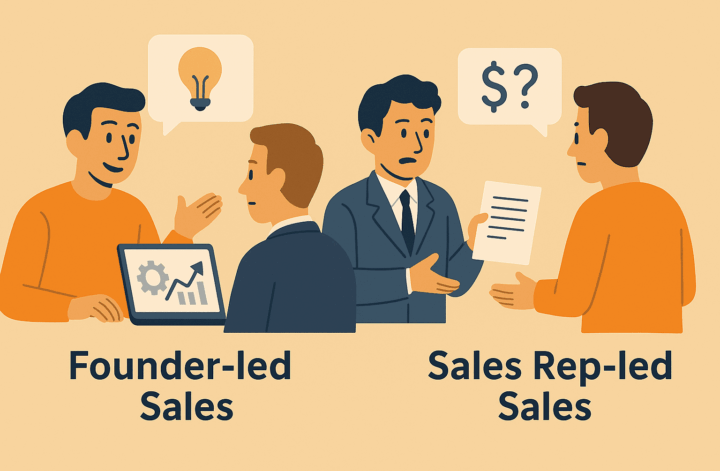
A colleague recently said something that stuck with me: “We can’t compare this year’s numbers to last year’s because the founders were leading sales back then.” That single comment opened a floodgate of reflection. In 2025, we shifted from founder-led to sales rep-led selling, and the differences have been striking. It goes beyond numbers—this change influences, the velocity of deals, and how consistently you can close them.

The Magic of Founder-Led Sales

Deep Product Knowledge = Shorter Sales Cycles

When founders sell, it’s not just about pitching a product—it’s about sharing something they’ve built brick by brick. They understand every use case, every feature limitation, and every hidden superpower of the product. So when clients throw curveball questions during technical demos, founders rarely need to “get back to you.” They answer right there, reducing turnaround time drastically. The client walks away with confidence, not a list of unanswered questions.

Instant Decisions During Negotiation

Founders also own the numbers. They know the margins. When a negotiation hits a pricing hurdle, they can instantly make calls—whether it’s a strategic discount or a custom deal structure—without needing approvals. This agility in decision-making helps maintain momentum and avoid stalls.

The Reality of Sales Rep-Led Sales

Onboarding Takes Time—And That Costs You

Now flip the script. Your rep is new. They’ve gone through onboarding, sat through internal demos, maybe even shadowed a few calls. But let’s be honest: it takes at least 3 months before a sales rep is fully ramped. During that ramp-up period, you’re essentially training them while hoping they’ll bring in revenue.

And even after ramp-up, they might still stumble on complex technical questions. That starts a game of ping-pong between sales and tech, and every delay adds friction to the buyer’s journey.

The Negotiation Bottleneck

Then comes the dreaded pricing talk. Rarely—especially in enterprise SaaS—do clients say “yes” to the original price. If you sell annual-licenses, with upfront-payments, the resistance is even stronger. Sales reps must now navigate internal pricing approvals, which adds layers of delay and undermines their ability to close with confidence.

The Underestimated Complexity of the Sales Funnel

And here’s the kicker: these are just the obvious problems.

When you’re looking at your sales pipeline on paper, everything seems neat—Meeting > Demo > Tech Evaluation > Negotiation > Close. But in practice, each stage hides its own chaos.

For instance, your rep-led team has an amazing “Meeting Qualified to Demo Done” conversion rate. But when it comes to “Demo to Technical Evaluation,” they hit a wall. Why? Because of issues like API incompatibility with the client’s infrastructure or product accuracy, etc. No CRM dashboard will tell you that—you need to dig deep to uncover it.

Fixing the Leaks Before Q4

Right now, I am trying to diagnose and fix these issues in the pipeline. We’ve removed founders from direct sales in 2025, and yes, the pipeline has taken a hit. But this shift also forced us to treat sales as a system—a process that must work without founder heroics.

The only way to fix it? Identify where exactly the conversions drop, why they drop, and build internal knowledge systems, pricing tools, and enablement content to bridge those gaps. Integration issues? Build an FAQ and demo kit. Accuracy concerns? Add clarity to the onboarding material. It’s time consuming but every small fix compounds!

Final Thoughts: Founder-Led Sales Aren’t Scalable

Founder-led sales might seem like a cheat code—but they’re not sustainable. They mask flaws in your product, processes, and pricing strategy. When founders sell, they’re plugging those gaps manually. When sales reps sell, those gaps become obvious—and painful.

But that’s a good thing. Because now, you can fix them.

I’m currently in this transition and will share how Q4 unfolds in a follow-up article. In the meantime, if you’re moving from founder-led to rep-led sales, think of each sales rep as a lens. The obstacles they face often reveal the hidden weaknesses in your overall sales process.

Continue Reading